
Some games tell you a story.
Some games let you optimize a spreadsheet with wooden tokens.
Ark Nova somehow does both.
The pitch is simple: you’re building a modern zoo. You’re balancing conservation projects, animal enclosures, sponsors, and public appeal. The player who most successfully balances conservation credibility with raw crowd appeal wins.
On paper, that sounds like a theme pasted on top of a euro engine.
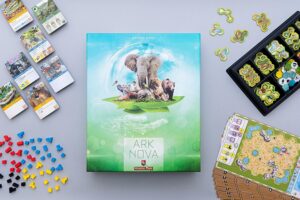
At the table, it feels surprisingly immersive.
I didn’t win my first game. The host did. Of course he did. It’s his game. He knows the sharp edges. He knows which card synergies are traps and which ones quietly snowball.
Still, halfway through that first play, I stopped caring about who was ahead and started caring about whether I could justify squeezing a snow leopard enclosure between my reptile house and aviary.
That’s when I knew this one was different.
The Core Loop: Cards, Conservation, And Calculated Decisions
Ark Nova revolves around five action cards that slide up and down in power depending on when you use them.
Build. Animals. Cards. Sponsors. Association.
Every turn you choose one, and its strength depends on its position in your row.
It’s elegant. It’s tense. It rewards sequencing without feeling punishing.
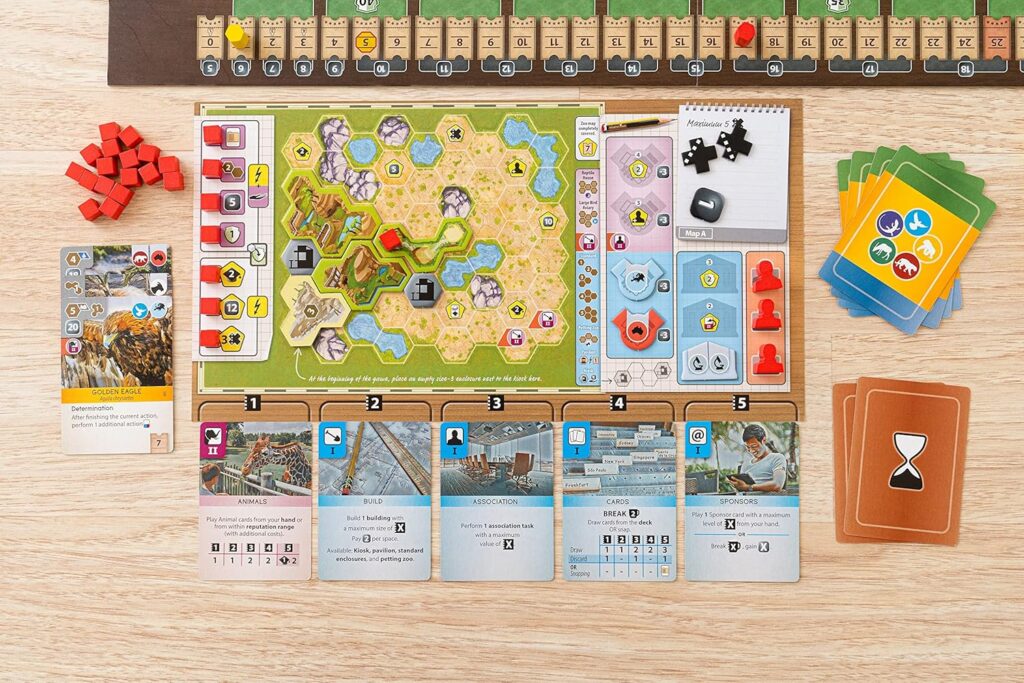
You want to play your Animals action when it’s at full strength so you can drop something impressive like a massive herbivore into a properly sized enclosure. But maybe you need to Build first. Or Cards to draw deeper into your deck.
The push and pull is constant.
And because almost everything flows through the multi-use card system, the theme never disappears. Every animal card feels distinct. Tigers aren’t just “4 appeal, 2 conservation.” They require specific enclosures, continent icons, and often synergize with other species.
You’re not just optimizing numbers.
You’re constructing an ecosystem.
The Dual Scoring Track Is Genius
Ark Nova’s scoring system is one of its strongest design choices.
Instead of a simple victory point track, you have two markers moving toward each other: appeal and conservation.
Appeal represents ticket sales, buzz, public interest.
Conservation represents credibility, projects, and long-term impact.
The game ends when the two markers cross.
It’s brilliant because it forces balance.
You can’t just spam flashy animals and ignore conservation. You can’t hide in nonprofit virtue signaling and ignore crowd draw. You need both.
The host in my first game understood this instinctively. I did not.
I chased appealing animals. Big cats. Impressive birds. Cards that looked exciting.
He quietly invested in conservation projects early. He built infrastructure that amplified long-term scoring. By the time I realized my mistake, his tracks were converging efficiently.
It didn’t feel broken. It felt earned.
That’s an important distinction.
Theme That Actually Breathes
Here’s where Ark Nova surprised me.
Many heavy euros slap on a theme like a sticker. You’re technically colonizing Mars, or technically trading spices, but emotionally you’re rearranging cubes.
Ark Nova gives you moments.
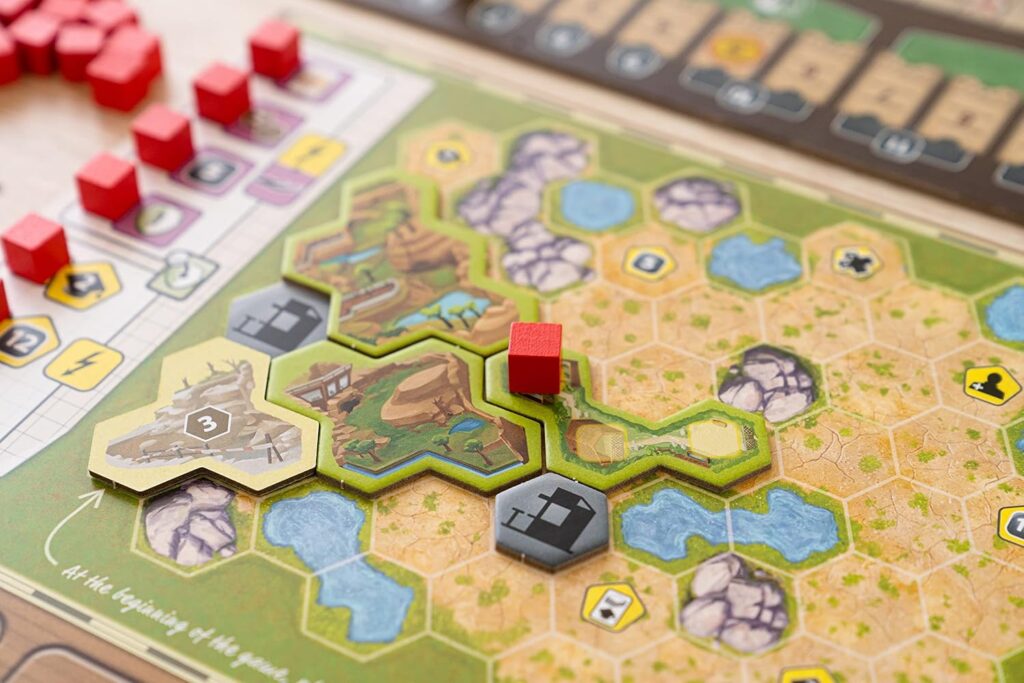
You glance at your board and see a sprawling layout of enclosures. A petting zoo in one corner. A research institute tucked next to a primate house. A conservation partnership in Africa unlocking access to specific species.
You start caring about adjacency bonuses because they feel spatial.
You debate whether to release animals into conservation because it feels thematic, not just efficient.
At one point I had a pair of flamingos that unlocked a synergy bonus, and I genuinely felt like I’d curated something cohesive.
That’s rare in a euro of this weight.
Yes, It’s Heavy. No, It’s Not Miserable
Ark Nova sits firmly in the heavy category. This is not a gateway game.
There are iconographies to learn. Card effects to parse. A decent amount of table space required.
Your first game will run long. Ours did.
Still, the weight feels purposeful.
There are no “why is this rule here?” moments. Everything feeds the central tension: how do I grow my zoo responsibly and profitably?
It’s less punishing than something like Food Chain Magnate and less opaque than some Lacerda designs. You have flexibility. You can pivot mid-game.
Even when you’re behind, you feel like you’re building something meaningful.
That emotional continuity matters.
The Animal Deck Is A Character
One of the quiet strengths of Ark Nova is the animal deck itself.
The variety is absurd. Mammals, reptiles, birds, aquatic species, each with continent tags and enclosure requirements.
The deck feels alive.
You’re constantly scanning the card row hoping for something that matches your zoo’s direction. If you’ve invested in Africa icons, you want African species. If you’ve leaned into reptiles, you’re hunting for synergy.
It creates that subtle card-draw tension that makes heavy euros addictive.
You’re not just drawing cards.
You’re scouting acquisitions.
And because each animal card features real-world information, the theme seeps in organically. You start recognizing species. You start remembering which animals require special enclosures.
It becomes tactile.
Balance And Player Agency
I lost my first game by a comfortable margin.
And I didn’t feel cheated.
That says something.
The system is tight. There’s no obvious runaway strategy. Conservation-heavy builds can win. Appeal-first builds can win if they pivot correctly. Sponsor engines can quietly dominate if nurtured.
The host didn’t win because he found a loophole.
He won because he sequenced better. He understood tempo. He knew when to invest in association actions early.
That kind of balance is what makes a game replayable.
You don’t feel forced into one path.
You feel invited to experiment.
Comparison To Other Heavy Euros
Ark Nova inevitably gets compared to Terraforming Mars.
Both use sprawling card decks. Both reward engine building. Both can feel long.
The difference is pacing and structure.
Terraforming Mars often feels like an economic ramp race. Ark Nova feels more spatial and curated. Your personal zoo board gives physical shape to your decisions.
It also feels more grounded.
There’s something inherently satisfying about placing a large enclosure and imagining which animal fits there best.
Terraforming Mars feels epic.
Ark Nova feels intimate.
That’s not better or worse. It’s just a different flavor.
Where It Fits On A Real Shelf
Ark Nova is not a casual Tuesday night game.
This is a Saturday afternoon commitment. Coffee on the table. Phones away. Rules refresh ready.
It demands attention.
But it rewards it.
If your shelf already includes heavy hitters and your group enjoys games that stretch past the two-hour mark, this belongs there.
If your group struggles with icon overload and long teach times, this might gather dust.
Know your table.
That’s always the real meta.
The Experience Of “Getting Into It”
About halfway through my first play, something clicked.
I stopped thinking about optimization in isolation and started thinking about zoo identity.
Was I running a reptile-focused institution? A conservation-first sanctuary? A high-appeal tourist magnet?
That shift from calculation to narrative is where Ark Nova shines.
You can get into it.
You can feel like your zoo is coherent.
When a game at this weight manages to evoke that feeling, it’s doing something right.
Replay Value And Long-Term Appeal
With the sheer volume of cards and multiple maps included, Ark Nova has serious legs.
Different map layouts change enclosure placement incentives. Different conservation projects push you toward new strategies.
You won’t exhaust this quickly.
And because the game rewards subtle sequencing improvements, each play feels like skill progression rather than luck variance.
The second time you play, you notice things you missed.
The third time, you see lines earlier.
That learning curve is satisfying.
Final Thoughts From A First-Time Loser
I lost.
I had fun.
I immediately wanted to play again.
That’s the trifecta.
Ark Nova manages to be heavy without being joyless. Strategic without being sterile. Thematic without being shallow.
It asks you to think.
It rewards you for caring.
And at the end, when your appeal and conservation tracks finally cross, it feels like the culmination of an actual project.
Not just a math exercise.
If you enjoy games where your decisions compound, your engine evolves, and your board tells a story by the final turn, Ark Nova deserves your table time.
Just be prepared.
If it’s the host’s copy, they might quietly build the better zoo the first time around.


0 Comments