
There’s a specific moment that happens during a long game weekend.
You’ve just finished a three-hour heavy euro. The table is covered in wooden bits. Someone is recalculating a final score because of a missed adjacency bonus. Your brain feels like it ran a marathon in dress shoes.
Or maybe you just wrapped a three-hour Commander session where someone tried to resolve Expropriate and the stack turned into a legal dissertation.
You need a reset.
Not a full shutdown. Just a mental stretch.
That’s where Love Letter lives. Also Skull. Love that game.

Tiny box. Maybe 20 minutes. Barely any components. And somehow, more table tension than games with 200 cards and a player aid sheet the size of a placemat.
I’m a big fan of light games. Not because they’re shallow. Because they’re strategic in a different way. They don’t test your ability to manage 14 resource types. They test your ability to read people.
Love Letter is one of the cleanest examples of that design philosophy.
The Simplicity Is The Hook
Here’s the whole thing.
You get one card in hand. On your turn, you draw one card. You now have two. You play one and resolve its effect.
That’s it.
There are only a handful of card types. Each has a number and a specific ability. Some let you guess another player’s card. Some force discards. Some protect you for a round. One is extremely powerful but risky.
You’re trying to be the last player standing in a round or hold the highest value card when the deck runs out.
That’s the structure.
No board. No tracks. No miniatures.
Just cards and suspicion.
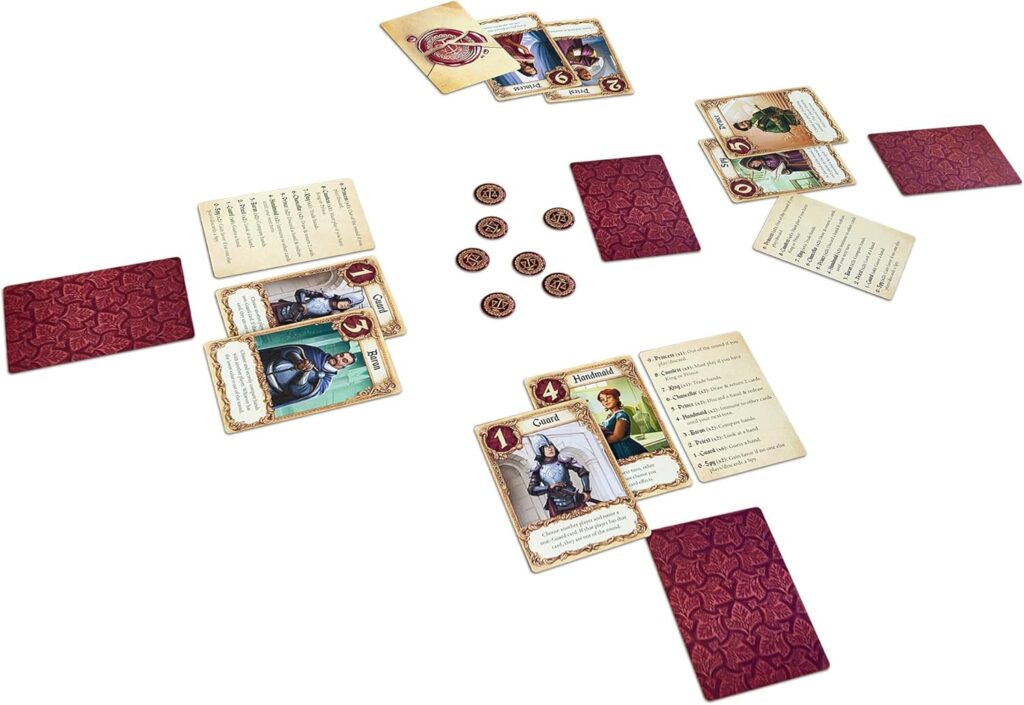
The elegance is almost insulting. You think, “This can’t possibly hold up.”
Then someone guesses your card correctly on turn one and you’re out.
And suddenly it’s personal.
Every Decision Feels Exposed
Because you only ever hold one card after your turn, information density is intense.
If you discard a high-value card early, everyone notices. If you hesitate before playing something, people read into it. If you choose not to target someone, they wonder why.
There’s nowhere to hide.
In heavier games, you can disappear into your engine. In Love Letter, every play is a social signal.
That’s the genius.
You aren’t calculating long-term optimization trees. You’re managing perception in real time.
Who looks confident? Who looks nervous? Who is protecting themselves suspiciously often?
It’s light mechanically. It’s sharp socially.
The New Edition Adds Just Enough
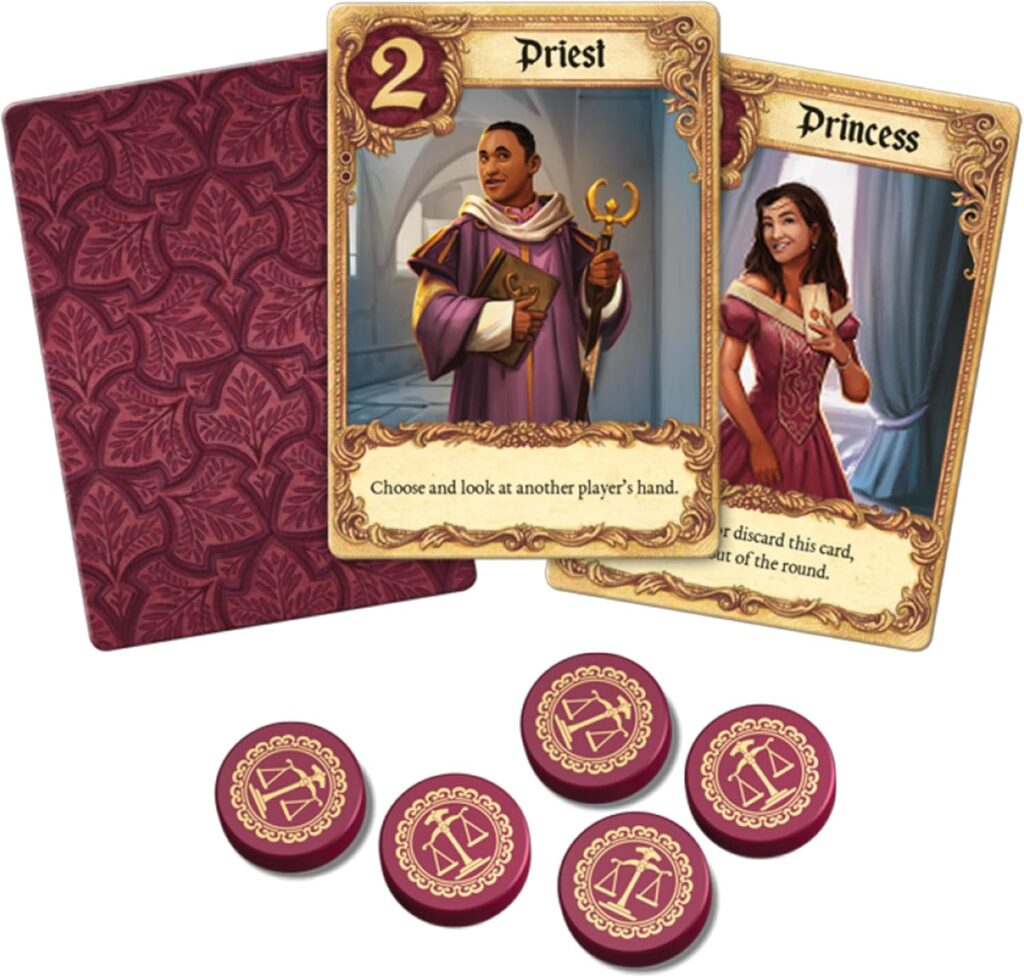
The 2019 and now 2025 editions expanded the player count and added a couple of new characters. The Chancellor lets you manipulate the bottom of the deck after drawing two cards. The Spy rewards you if you were the only one to play or discard one during the round.
Those tweaks sound minor.
They’re not.
The Chancellor adds a subtle layer of control in a game that’s otherwise chaos-adjacent. The Spy introduces a quiet metagame where you track who has used what.
With up to six players, the table energy scales beautifully. More suspicion. More accidental eliminations. More laughter when someone confidently names the wrong card and eliminates themselves.
It stays fast.
That matters.
Why It Works After Heavy Games
My friends and I periodically have game weekends. Two huge heavy games in a row. Or a heavy euro followed by a long Magic session that leaves everyone slightly dehydrated and overanalyzing their life choices.
Dropping Love Letter in that space feels like opening a window. Right before you once again regret your life choices and hit up Taco Bell.
It’s quick. It’s punchy. It doesn’t require re-learning an icon language.
You can teach it in under five minutes. Even less if your group has played it before.
Your brain shifts gears. You’re not calculating efficiency ratios anymore. You’re watching eye contact.
That change of mode is refreshing.
It’s like palate cleanser sorbet between courses.
Comparison To Skull And Other Microgames
If you’ve played Skull, you know that feeling of tension packed into almost nothing. A few coasters and bluffing turn into a social showdown.
Love Letter lives in that same ecosystem.
The difference is that Love Letter has more mechanical structure. You’re not purely bluffing. You’re deducing based on limited information and forced discards.
It scratches a slightly different itch.
Skull is bravado.
Love Letter is quiet suspicion.
Both are excellent in the right mood.
The Elimination Question
Yes, there’s player elimination.
In a long game, that’s a red flag. In a 10-minute round, it’s a feature.
If you’re knocked out early, you’re barely sidelined. You watch the rest of the round unfold, you gather information for the next one, and you’re back in.
It keeps stakes high without creating resentment.
Because rounds are short, the pacing absorbs the elimination pain.
You don’t stew.
You smirk and plan revenge.
Accessibility And The Kid Question
One of the reasons I keep Love Letter in the rotation is accessibility.
The rules are simple enough that older kids can jump in quickly. There’s no sprawling board state to track. No complex timing windows.
That said, the theme centers around delivering a letter to a princess who is seeking a suitor and confidant. It’s lighthearted and storybook-level, but depending on your household you might want to wait until kids can process the theme as playful rather than romantic in a grown-up sense.
Mechanically, though, it’s accessible.
And because it relies on deduction and reading people, it actually helps younger players develop subtle skills beyond just arithmetic.
Replayability In A Tiny Deck
You’d think a game with such a small deck would burn out quickly.
It doesn’t.
The replay value comes from the players, not the cards.
Each group develops its own metagame. Certain players become known for aggressive guessing. Others for conservative protection plays. Patterns emerge. Then someone breaks them.
Because the card count is tight, probabilities are tangible. You start mentally tracking what’s been discarded. You start calculating the likelihood of someone holding the Princess or the Guard.
It’s light, but it’s not random.
That balance is hard to nail.
Table Presence And Production
The newer editions feature Andrew Bosley’s artwork, which gives the game a soft, storybook feel. The screen-printed tokens are a small but satisfying upgrade. They feel good in hand. They don’t look cheap.
And the box is tiny.
It disappears into a backpack. It fits on crowded tables. It travels well.
In a hobby full of coffin-sized boxes, there’s something refreshing about a game that fits in your palm and still delivers tension.
Who This Is Not For
If your group dislikes deduction. If elimination triggers long sulks. If you prefer purely strategic engines over social reading.
This might not hit.
Love Letter thrives on eye contact and playful paranoia.
If your table culture is hyper-competitive and analytical, you may find it too breezy.
That’s fine.
Know your table.
Where It Fits In A Collection
Love Letter isn’t your main event.
It’s your intermission.
It’s what you pull out when people arrive early. When someone needs a bathroom break buffer. When you want to close a night without launching another two-hour commitment.
It’s also fantastic for mixed-experience groups. Hobby veterans can enjoy the mind games. Newer players won’t feel buried under rules.
That versatility earns it shelf space.
The Feeling Of A Perfect Round
The best Love Letter rounds are surgical.
You watch someone discard. You clock what’s left in the deck. You narrow down possibilities. You play a Guard and name the exact card in someone’s hand.
The table erupts.
That micro-moment of triumph feels outsized compared to the game’s footprint.
And when someone bluffs you into misreading them, that sting lingers just long enough to want another round.
That’s good design.
Final Thoughts From A Light-Game Fan
I love heavy games. I love sprawling boards and intricate engines and multi-turn plans.
But I also love breathing.
Love Letter provides that breath.
It’s simple without being stupid. Quick without being hollow. Social without being chaotic.
In a hobby that sometimes confuses weight with quality, Love Letter is a reminder that elegance still wins.
You don’t need 200 cards to create tension.
Sometimes 16 is enough.
And sometimes, after three hours of calculating mana curves and debating stack interactions, that tiny red box is exactly what your brain ordered.


0 Comments