
A Family Game Night That Actually Gets Requested Again
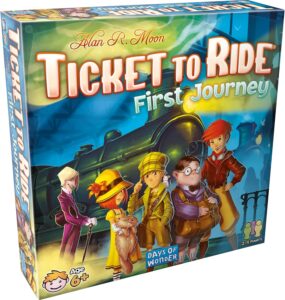
Ticket to Ride: The First Journey is one of those games that quietly earns its place. No hype machine. No “parents will love this too” nonsense on the box that turns out to be wishful thinking. You open it, teach it in minutes, play a round, and then someone immediately asks if you can play again.
That alone puts it ahead of a very long line of kids board games.
I am a fan. My seven year old daughter loves it. My nine year old son loves it. And I genuinely enjoy playing it with them. Not in a martyr way. In a “this is actually fun” way.
That distinction matters more than publishers like to admit.
This Is Not A Hollow Kids Reskin
A lot of junior or kids editions feel like someone took a real game, removed the interesting decisions, slapped brighter colors on it, and called it a day.
Ticket to Ride: The First Journey does not feel like that.
Yes, it is simpler than the full version. Obviously. But it still feels like Ticket to Ride. You are collecting colors. You are claiming routes. You are racing other players to key connections. You are making choices that have consequences.
It feels streamlined, not stripped.
That is the difference between a kids game that gets shelved after a month and one that sticks around.
The Teach Is Fast Enough To Keep Momentum
If you play games with kids, you already know this truth.
A long teach kills excitement.
Ticket to Ride: The First Journey avoids that entirely. You can explain the game in a few minutes without diagrams, flowcharts, or stopping every thirty seconds to clarify an edge case.
On your turn, you draw cards or you claim a route. Routes need matching colors. Complete tickets, score points. Done.
Kids grasp it quickly. Adults do not feel like they are translating rules into another language. You start playing almost immediately.
That early momentum carries through the whole game.
Pacing That Respects Attention Spans
This game moves.
Turns are quick. Downtime is minimal. There is always something happening on the board that feels relevant to everyone at the table.
That pacing keeps kids engaged without turning the experience into noise. It feels active but controlled.
Nobody is waiting ten minutes for someone to optimize their hand. Nobody checks out halfway through a round. That is harder to pull off than it looks.
Enough Strategy To Feel Clever
Here is the part that surprised me.
There are moments where you actually stop and think.
Do I grab this route now or risk waiting.
Do I draw cards and hope the colors come up.
Do I block this connection or focus on my own tickets.
These are not brain melting decisions, but they are real. Kids feel smart when they make them. Adults do not feel insulted by them.
That balance is rare. Many kids games miss it entirely.
The Board And Components Do Real Work
The production quality helps the game succeed.
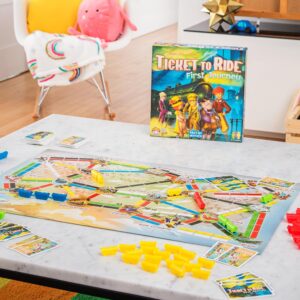
The board is clear and readable. Routes are easy to understand at a glance. The trains are chunky enough to be satisfying without being fiddly. The cards are simple and legible.
Nothing here feels cheap or confusing. That reduces friction and keeps the focus on playing, not interpreting.
Kids notice that. Parents benefit from it.
It Holds Adult Attention Without Trying Too Hard
I have not played the full version of Ticket to Ride in years, so I am not going to pretend I remember every difference. What I can say is that while playing Ticket to Ride: The First Journey, I never felt bored.
It does not feel like you are babysitting a game.
You are still watching opponents.
You are still reacting to the board.
You are still making small tactical calls.
That is why it works so well at mixed ages. Everyone is engaged at their own level, but nobody feels left behind or talked down to.
Competition Without Emotional Fallout
This is an underrated strength.
The game is competitive, but it is not brutal. Blocking happens, but it is rarely devastating. Losing feels disappointing, not crushing.
That makes it a strong fit for siblings who are close in age but very different emotionally. There is tension without meltdown territory.
If you have ever had a game night derailed by tears, you understand how valuable that is.
Replay Value That Exceeds Expectations
Some kids games burn out fast. You play them a handful of times and everyone has seen everything.
Ticket to Ride: The First Journey holds up better than that.
Different ticket draws change priorities. Player choices shape the board in noticeable ways. Kids start experimenting, trying new routes, planning ahead instead of reacting.
It does not have endless depth, but it has enough variety to stay interesting across many plays.
A Gateway Game That Actually Teaches Skills
This game quietly builds good habits.
Planning ahead.
Reading the board.
Balancing short term gains against longer goals.
Handling light interaction.
Kids who play this are absolutely better prepared for bigger board games later. It introduces those concepts naturally, without making a big deal about it.
That is exactly what a gateway game should do.
Who This Game Is Perfect For
Families with kids roughly seven to ten years old.
Parents who want to play alongside their kids, not supervise them.
Households that enjoy real board games but need something accessible.
Game nights where nobody wants to spend half an hour reading rules.
If that sounds like your situation, this game fits cleanly.
Final Thoughts
Ticket to Ride: The First Journey succeeds because it respects everyone at the table.
It respects kids by giving them real decisions.
It respects adults by not wasting their time.
It respects families by keeping the experience fun instead of stressful.
That combination is harder to find than it should be.
This one earns its spot on the shelf.


0 Comments